
AI-Native Services: Notes from the Room with Four Entrepreneurs

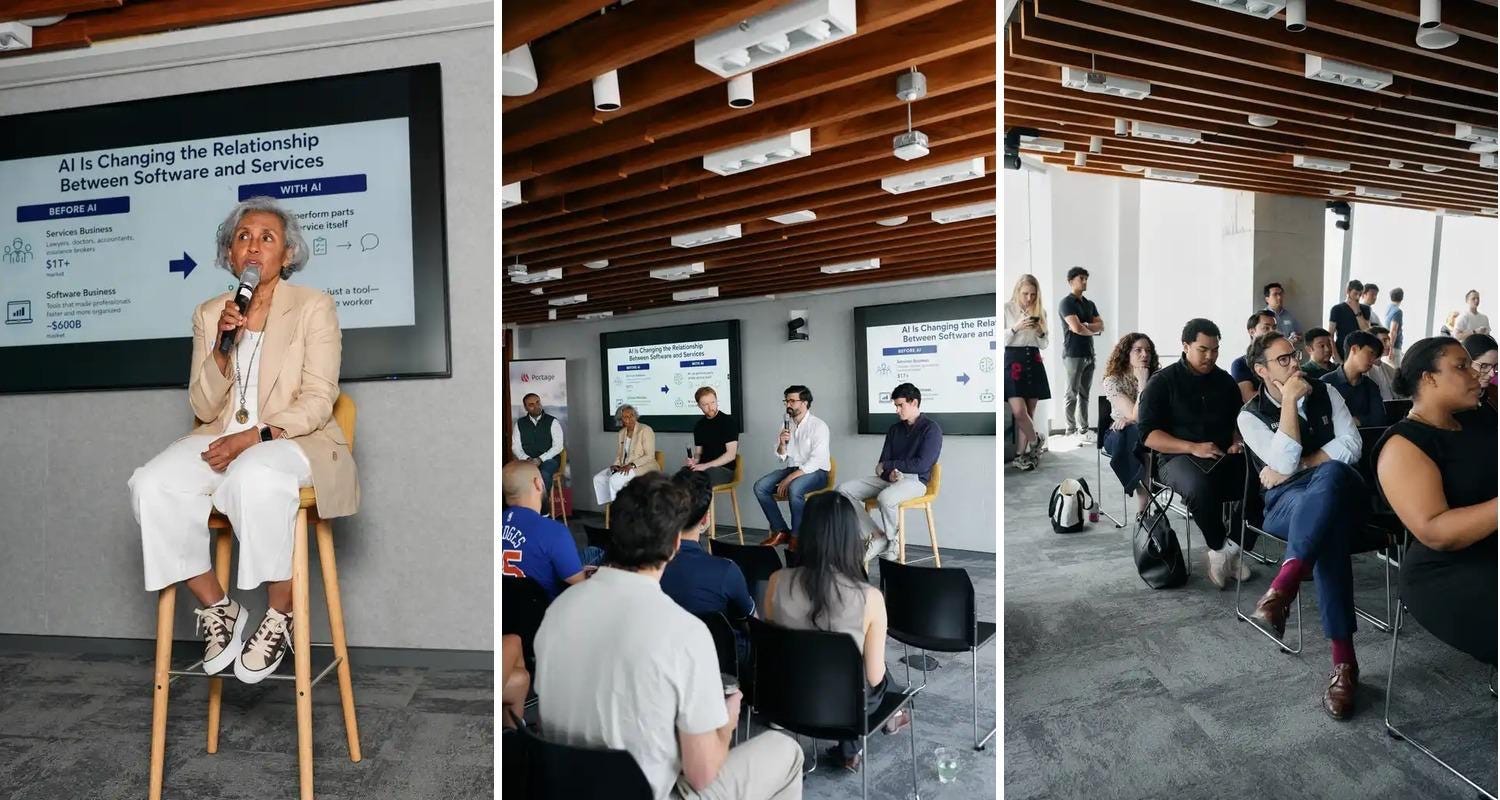
We recently brought together four entrepreneurs building AI-native services companies. They are rebuilding the delivery model entirely around what AI can do.
The companies in the room were: Elysian (A Portage-backed AI-native third-party administrator for complex commercial insurance claims), Evidenza (synthetic research platform replacing traditional market research with AI-modeled buyer personas), DocShield (AI-native insurance brokerage for medical professionals), and Hanover Park (an AI-native fund administrator providing accounting and financial reporting to VC, PE, and private credit funds). The session was moderated by Rohit Saha from Sagard’s AI team.
The conversation covered five themes worth carrying forward.
The non-linear scaling thesis, and what it actually requires
Traditional professional services scale linearly: more revenue means more headcount. The promise of AI-native services is that this curve bends. But as Grace Hanson of Elysian put it, efficiency alone doesn’t get you there. The real unlock is deeply enriched AI with subject matter expertise. Models that understand the domain well enough to make consequential decisions, not just process faster. Hanover Park’s approach captures this concretely, they track 8 to 10 “productization metrics” daily, with a key one being the percentage of transactions auto-categorized by AI without human review.
Where humans stay
The founders in the room spoke about the evolving roles for human talent. The regulatory landscape in most of their industries require humans in the loop or maybe better put as humans in the lead. What’s changing is what humans do. Grace noted that today, humans spend roughly 60% of their time contextualizing information by gathering, formatting, summarizing. That work moves to the model. What remains is strategizing and relationship building. Jon Lombardo of Evidenza described this as a “middle to middle” model: humans own the brief at the front end and the verification at the back end. AI handles everything in between. The result is that a single research director can run 10 to 30x more projects than before.
Deployment is the product
A consistent theme across the group was that implementation is where AI-native companies win or lose. The first 100 days with a customer are critical. Over-invest in deployment resources. Build teams with dedicated customer success and deployment strategy capacity. The risk isn’t that the AI doesn’t work, it’s that it gets bolted onto old workflows rather than used to reimagine them. Advice was to start from what AI can do and work backwards, not the other way around.
Where to find the right category
The most useful market entry signal the group identified was service fragmentation plus Jevons’ paradox (the idea that making something cheaper and faster expands total demand rather than just redistributing it). When there is a fundamental undersupply of a service, where demand would actually expand if the cost came down, AI-native delivery can create a new market rather than just taking existing share. Pair that with high fragmentation, low NPS from existing providers, and weaker incumbents who haven’t traditionally had to compete on quality, and the group felt you have conditions worth targeting. Several entrepreneurs said the best categories are the ones that have been systematically underserved and unloved, often because the economics of improving them never made sense until now.
Pricing and token economics
The panel agreed the real cost driver in AI-native services isn’t API spend, but orchestration. Senior human time that is spent directing, reviewing, and refining what the model produces is where costs compound. Every API call re-sends the full conversation history, so complex multi-step workflows multiply cost vs. just add it. Better unit economics come from reducing that orchestration overhead over time, not from managing token spend.
This points toward what the panel called “token maxing,” essentially maximizing AI usage relative to human staffing. The best margins will go to companies that restructure workflows entirely around what the model can own early on. The structural advantage is available now, for any team willing to rethink how the work gets done rather than what the tokens cost.
The energy during this New York Tech Week session was real. These leaders are reimagining what professional services can be, not layering AI into existing business models. They are rebuilding them from scratch.
This article was authored by Joanna Harries, Sagard’s Managing Director of Partnerships.
 | A guest post by
|